Research Exhibit
From Simple Rules to Living Systems: Cellular Automata and the Edge of Chaos
Complex, life-like behavior can emerge from extremely simple rules, and the most interesting forms of this complexity occur at the boundary between order and chaos: the Edge of Chaos.
This exhibit explores how cellular automata generate structure, computation, and persistent complexity at the edge between order and chaos.
Next →Scroll through the chapters to explore theory, simulation, and researchers who shaped the field of complex systems.
Foundation
Local rules that scale into structure
A cellular automaton is a discrete computational system composed of a grid of cells, updated over discrete time steps.
Each cell’s next state is determined only by its neighborhood (the local neighbors within a fixed radius), using a simple deterministic rule.
- discrete grid structure
- local interaction rules
- synchronous time updates
- emergent global behavior
Even with these constraints, cellular automata can exhibit surprising complexity, especially near the boundary between order and chaos.
1D Cellular Automata
Elementary rules and evolving patterns

- - Physicist and mathematician
- - Founder of Wolfram Research and Mathematica
- - Catalogued all 256 elementary 1D cellular automaton rules
- - Classified them into four behavioral classes
- Proved that the simplest possible rule systems can generate irreducible complexity, laying the groundwork for understanding where the edge of chaos lives in 1D automata.
In one dimension, the “neighborhood” is especially clear: each cell depends on itself and its immediate left/right neighbors.
A single rule number encodes the outcome for all possible neighborhood configurations. As the rule changes, behavior can shift from periodic order to randomness and computation-like complexity.
Stephen Wolfram catalogued all 256 elementary rules and found that a handfulproduce behavior complex enough to support universal computation.
Select a preset or drag the slider to change the rule. Click any output cell in the rule table to build a custom rule. Choose a starting condition and press Start.
2D Cellular Automata
Game of Life and emergent motion
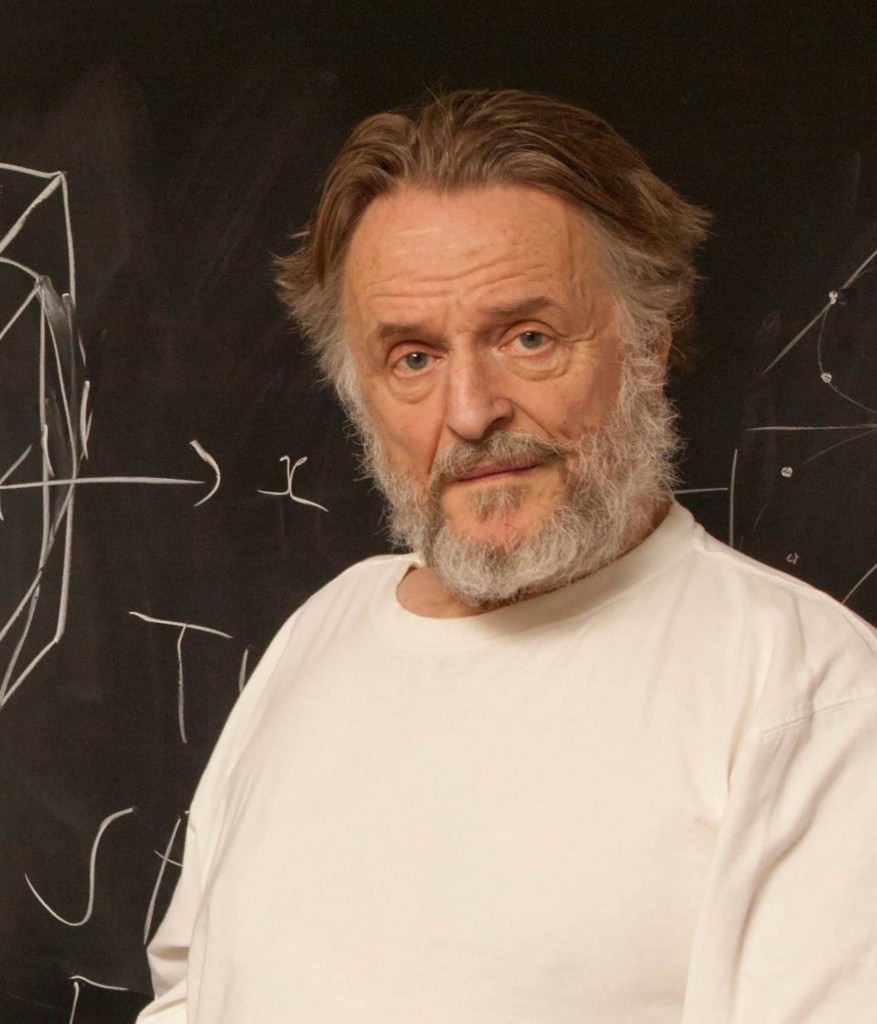
- - Mathematician at Cambridge
- - Created the Game of Life (1970)
- - Developed a 2D cellular automaton with simple rules
- - Demonstrated emergence of complex patterns
- Showed that simple rules can produce lifelike complexity and even universal computation.
In 1970, mathematician John Conway created a famous two-dimensional cellular automaton: the Game of Life.
Watch for how interaction between local structures amplifies into global motion and sustained activity.
This chapter emphasizes interpretation: understand how local neighbor interactions scale into persistent, life-like organization.
Click or drag to draw cells. Select a pattern to place it, then press Start.
Edge of Chaos
Where order meets unpredictability

- - Computer scientist
- - Founder of Artificial Life
- - Introduced the "Edge of Chaos" concept
- - Studied phase transitions in cellular automata
- Proposed that complexity and computation emerge at the boundary between order and chaos.
Artificial Life → Cellular Automata → Lambda Parameter → Edge of Chaos
"Life exists at the edge of chaos."
The key idea: persistent complexity often emerges when a system is neither fully ordered nor fully random.
Drag the slider to move between order, the edge of chaos, and full randomness. Watch how the cellular automaton behavior changes.
Edge of chaos: Life sits at the boundary between order and chaos; complex, persistent structures like gliders emerge.
Edge of Chaos in the Real World
How cellular automata connect across disciplines
Nature
How edge-of-chaos dynamics appear in natural systems
- Ordered: uniform ice sheets with no branching structure
- Chaotic: random irregular crystals with no recognizable form
- Edge of chaos: intricate fractal branching patterns unique to each snowflake

- Ordered: solid uniform color across the entire skin surface
- Chaotic: random noise with no coherent pattern
- Edge of chaos: stripes and spots that repeat with local variation

- Ordered: when vegetation is too sparse for fire to spread at all
- Chaotic: uniform burning that consumes everything instantly
- Edge of chaos: complex branching fire fronts that resemble real wildfire behavior

Economics
Markets are complex adaptive systems, and like living systems, they are healthiest when operating near the edge of chaos. Too much regulation locks markets into rigidity; too little regulation leads to crashes and unpredictability.
- Ordered: no innovation, stagnation, no price discovery
- Chaotic: crashes, bank runs, systemic collapse
- Edge of chaos: adaptive growth, competition, resilience
The 2008 financial crisis is a case study in what happens when a system tips from the edge into full disorder; local risk decisions cascaded into global collapse.


Networks and Distributed Systems
Distributed systems like the internet or cloud infrastructure need to balance stability and flexibility. Too much structure makes them fragile, while too much randomness makes them unstable.
- Ordered: the system becomes fragile, unable to adapt to traffic spikes or failures
- Chaotic: no consistency, no reliability, no coordination between components
- Edge of chaos: scalable and resilient, stable enough to be reliable, flexible enough to adapt
The most effective distributed systems operate near the edge of chaos, where stability and adaptability coexist, handling millions of users and unpredictable demand without collapse.
Conclusion
Cellular automata demonstrate that complex, life-like behavior does not require complex rules, only simple local update mechanisms.
The most compelling dynamics tend to appear near the boundary between order and chaos, where persistent structure and adaptive variability can coexist.
By combining interactive simulations with theoretical context, this exhibit shows a pathway from simple rules to living systems.